
How actions resolve
In the Patrol/Story simulation, your side begins, then sides alternate. Each operational unit on the acting side resolves its action. A unit whose pilot has been killed needs a surviving co-pilot to continue; uncrewed drones remain operational. This is squad turn resolution, rather than movement on a tactical grid. The battle log shows misses, hits and triggered effects.
The run proceeds to the next floor after the enemy squad is defeated. Mission completion requires clearing the mission’s floor count. Losing the squad or retreating ends that attempt. Multiplayer and Pits reuse the shared attack engine, while their encounter and victory rules differ.
Read hull and shields separately
HP is hull integrity. Shields absorb resolved damage before hull: a 30-damage hit against 20 shield removes 20 shield and 10 hull. Shield and hull regeneration are separate stats; do not assume a large shield also repairs hull.
Attack controls damage before mitigation. Defense reduces damage using a curve, not a flat subtraction and not a direct percentage. Evasion is the chance to avoid a hit after the accuracy check, capped at 60%.
READ YOUR COMBAT STATS

Hull / HP
The unit’s hull integrity. Incoming damage reaches this after shields.

Shield
Absorbs damage first. Shield regeneration is a separate stat.
Attack
Damage before defense, matchups and other attack multipliers.

Defense
Reduces damage using the defense curve; it is not a flat subtraction.
Evasion
A separate avoidance check after accuracy, capped at 60%.

Energy
Resource shown for abilities; read the attached ability’s actual requirements.
20 shield absorbed10 hull lostWorked damage-splitting example: damage reaches hull only after the available shield is exhausted.
IN THE GAME: READING A CARD
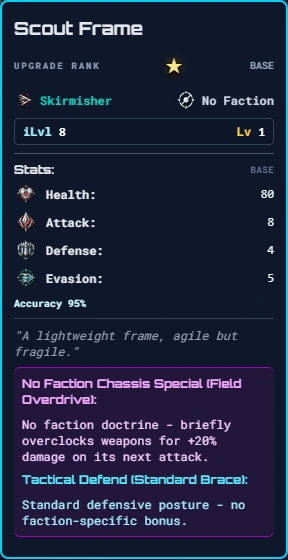
- 1
Card tier and rank
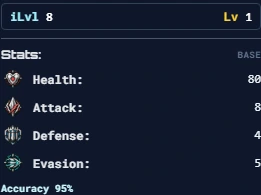
The Base label identifies the variant; the star belongs to the separate Workshop rank system.
- 2
Combat statistics
The icon and label identify each value: Health, Attack, Defense and Evasion.
- 3
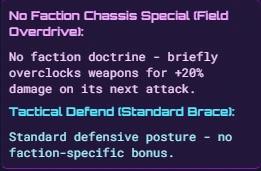
Frame abilities
Read the Chassis Special and Tactical Defend descriptions below the stats.
Why attacks miss
Normal attacks first face a 95% accuracy check and a separate target evasion check. With 10% target evasion and no special effects, the hit chance is 0.95 × 0.90 = 85.5%. A target can therefore be harder to hit than its evasion number alone suggests.
Suppression lowers accuracy by 15 percentage points to 80% for its duration. A phased target cannot be hit. Juggernaut stabilizers guarantee hits against Guardian targets unless they are phased. These are implemented exceptions, not a general accuracy equipment stat.
TWO CHECKS, NOT ONE
against 10% evasion=85.5%normal hit chance
Without suppression or special exceptions. Evasion is checked separately from accuracy.
Damage in a worked example
A normal successful attack uses Attack × 100 / (Defense + 100), then applies chassis, crew and other active multipliers. It then rolls damage variance from 0.85 to 1.15 and rounds, with at least 1 damage.
With 100 Attack against 100 Defense, the neutral pre-variance result is 50. Standard chassis advantage multiplies by 1.3, giving 65 before variance. A critical multiplies by 1.5; the ordinary critical chance is 5%. Special attacks and named passives can add further multipliers. These numbers illustrate the formula; they are not a promise that a particular card has 100 Attack.
BEFORE THE RANDOM DAMAGE ROLL
Then apply the 0.85–1.15 variance roll and rounding. Chassis advantage, crew specialty, critical hits and named effects can change the multiplier.
Use Specials and Defend deliberately
Every faction has a Chassis Special. Some consume an attack turn, while others apply an immediate support effect. Read the ability panel and cooldown on your frame’s page. The pilot’s faction passive is independent from the frame’s faction.
Defending holds the unit’s attack and changes how it handles incoming threats. Its faction-specific effect matters: check the linked Defend ability rather than assuming every faction braces identically. Automatic attacks still choose targets through the battle rules; there is no positional flanking system.
Your learning journey
Continue reading
Implementation sources
Guide explanations are maintained separately from the extracted database. This version was checked against:
components/RunSimulationScreen.tsxutils/combatEngine.tsutils/combatRules.tsutils/accuracy.tsutils/evasion.ts